
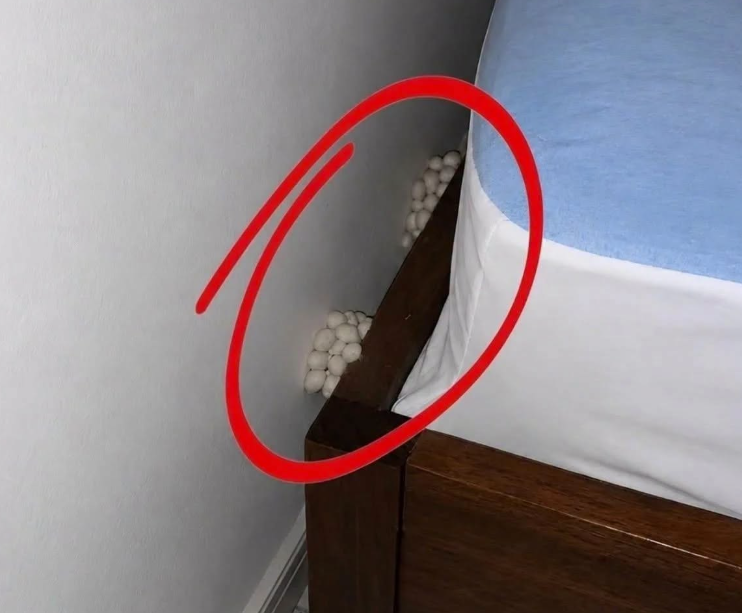
Could They Be Insect Eggs?
This is probably the first question most people ask after seeing a photo like this.
Fortunately, the answer is probably not.
Most insect eggs do not look like perfectly round white balls.
Depending on the species, insect eggs are usually:
- Oval or elongated
- Cream-colored or translucent
- Attached firmly to a surface
- Laid in organized clusters
- Much smaller than the beads shown in the image
Cockroach eggs, for example, are enclosed inside a protective capsule rather than scattered individually.
Spider eggs are typically enclosed in silk sacs.
Bed bug eggs are tiny, elongated, and glued to surfaces rather than lying loose on the floor.
For these reasons, the objects in the photo do not closely resemble common household insect eggs.
Could They Be Lizard or Gecko Eggs?
Another possibility that often comes to mind is reptile eggs.
Some lizards and geckos lay white eggs, but there are important differences.
Gecko eggs are usually:
- Much larger
- Laid in pairs
- Attached to a hidden surface
- Not found in large piles
Seeing dozens of perfectly identical white balls grouped together makes this explanation highly unlikely.
Could They Come from Packaging Materials?
Yes.
If you've recently purchased furniture, electronics, or fragile household items, the packaging may have contained polystyrene beads.
A damaged shipping box or torn protective cushion can easily release these tiny foam balls.
Since they are so light, they often spread throughout a room and collect behind furniture over time.
How to Identify What They Really Are
Before worrying about pests or infestations, perform a few simple checks.
1. Examine One Carefully
Wear gloves or use a tissue to pick up a single ball.
Ask yourself:
- Is it extremely light?
- Does it feel like foam?
- Can it be crushed easily?
- Does it bounce slightly?
- Does it have any unusual smell?
Polystyrene beads are incredibly light and compress easily when squeezed.
2. Search for the Source
Inspect nearby furniture and household items carefully.
Check:
- Pillows
- Cushions
- Bean bags
- Mattresses
- Stuffed toys
- Packaging materials
- Decorative cushions
A tiny hole is often enough for hundreds of beads to escape over time.
3. Clean the Area
Vacuum all of the beads thoroughly.
After cleaning, monitor the area for several days.
If no new beads appear, the problem has likely been solved.
If they continue appearing, there is probably still a damaged item releasing them.
The rest is on the next page
